
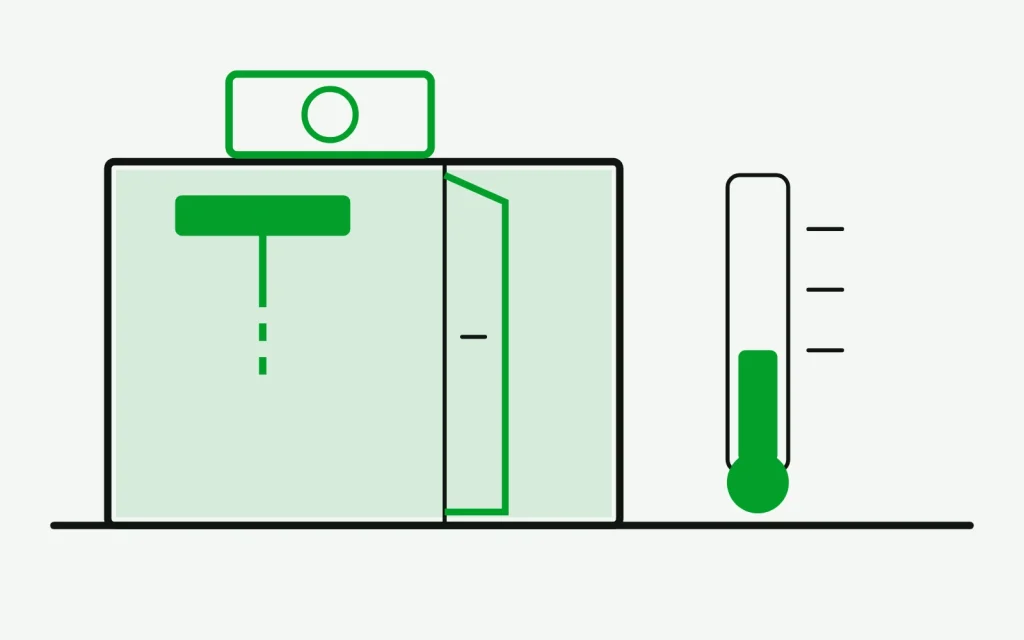
A walk-in that has drifted from 36°F to 44°F is not yet an emergency, and that is exactly why it is dangerous. Nothing has failed loudly, the compressor is running, product still feels cold to the hand — and the cooler has quietly spent the night above the temperature the health inspector measures against.
Cold holding for potentially hazardous food is 41°F or below under the FDA Food Code, which Massachusetts inspections follow. Above that, time-and-temperature control has failed whether or not anything looks wrong.
Check the door before you check the equipment
In a working kitchen, the most common cause of a warm walk-in is the door. A closer that has lost its tension, a gasket torn by a cart corner, a latch that no longer pulls the door tight, or a strip curtain missing half its strips — each of these lets a continuous exchange of warm humid air happen all service long.
The tell is ice. Frost building on the evaporator, on the ceiling near the door, or on product at the front of the box means humid air is being pulled in and frozen out. Fix the door and the frost problem usually goes with it.
Then check what the box is being asked to do
- Is warm product being loaded straight in? A box is sized to hold temperature, not to pull down a hot batch — that is what a blast chiller or an ice bath is for.
- Are the fan guards and the evaporator coil clear? Boxes stacked to the ceiling block the airflow the box depends on.
- Is the condenser clean and is its air path unobstructed? A rooftop or back-alley condenser packed with grease and lint cannot reject heat, and this is the single most common preventable failure in commercial refrigeration.
- Is the space around the condensing unit hotter than it should be? A unit installed in an unventilated closet fails first on the hottest day of the year.
Frost on the coil means the defrost cycle stopped
Every walk-in evaporator ices and then clears itself on a timed or demand defrost cycle. When the defrost heater, timer, or termination sensor fails, the coil fills with ice, airflow drops, and the box climbs — while the compressor runs continuously and the electric bill quietly goes up with it.
A coil that is a solid white block is not a mystery. It is a defrost fault, and running the box in that state does not fix it.
Log the temperature, because the log is the evidence
Two readings a day in a written or digital log does two things. It shows an inspector that temperature is being controlled rather than assumed, and it turns a slow drift into something visible before product is at risk. Most walk-in failures announce themselves over a week of readings and get noticed on the day the box is at 50°F.
Trust the log over the dial on the wall. Wall-mounted thermometers on old boxes are frequently out by several degrees, and the number that matters is product temperature, not air temperature at the door.
What to do while you wait for a technician
- Move the highest-risk product to another box or to ice, and record when you moved it.
- Keep the door closed and stop stocking the box.
- If the coil is iced solid, shut the refrigeration off and let the fans run to thaw it, with a drain path for the water.
- Note when the drift started. A box that fell overnight and a box that has been sliding for a week are different faults.
The version of this that does not happen
Nearly all of it is preventable on a schedule: condenser cleaning, gasket and closer inspection, defrost verification, and a charge check before summer. Emergency refrigeration work costs more than planned work, and it arrives at the worst possible moment, which for a restaurant is Friday evening.
We cover walk-in cooler repair and commercial refrigeration across Greater Boston, and scheduled visits are cheaper per year than the calls they replace — see service plans. If your box is drifting right now, call (617) 404-9944.
