
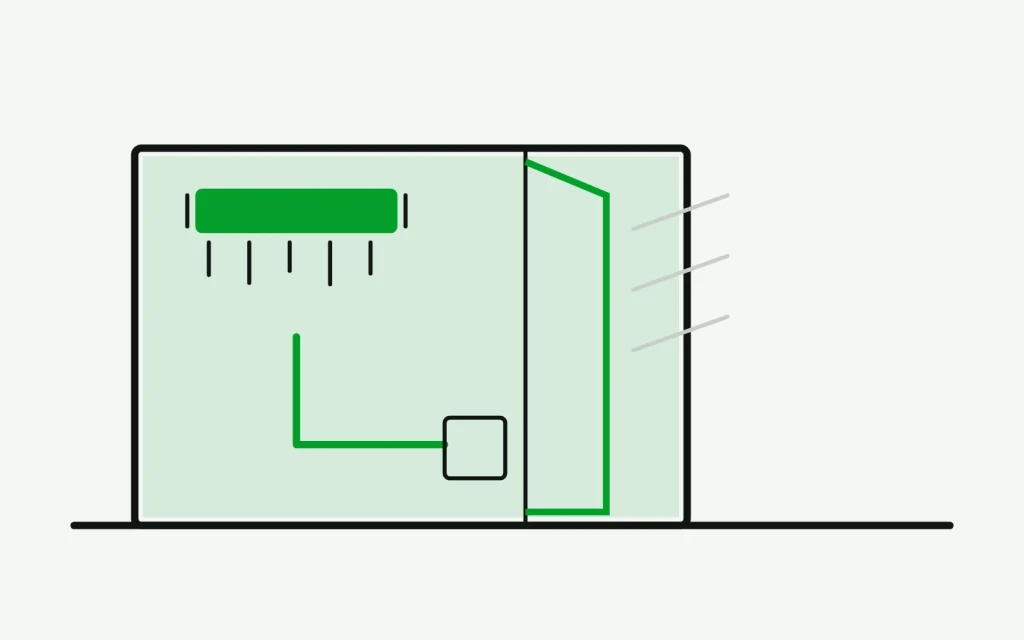
Frost inside a walk-in freezer is not weather. Every visible ice crystal was water vapor that rode in on warm air, and the pattern it makes tells you where that air is getting in and what stopped removing it.
Read the pattern before calling, because the two most common causes are things a kitchen can fix in an afternoon.
Ice near the door means the door
Frost on the ceiling by the entrance, on the door frame, or in a sheet on the floor just inside is infiltration. Somewhere in that doorway a seal is failing: a gasket cut by a cart, a closer that no longer pulls the door shut, a latch out of adjustment, a strip curtain hanging in ribbons, or a door held open on a delivery morning.
Freezer doorways also have heaters — in the frame, around the gasket, and often in the threshold — precisely because moisture wants to freeze there and weld the door shut. When one fails, ice builds where the heater used to be, which is why a door that suddenly needs a shoulder is an electrical fault rather than a strength problem.
Ice on the coil means the defrost cycle
A freezer evaporator is supposed to frost and then clear itself several times a day. When the defrost heater, the termination sensor, or the timer fails, the coil packs solid, airflow collapses, and the box climbs while the compressor runs without pause. The bill goes up in the same week.
The tell is a coil that is a white block rather than a coil with frost on it, plus fans that sound loaded or are hitting ice. That is a service call. Chipping at it with a knife punctures tubing and turns a heater replacement into a sealed-system repair.
Water on the floor means the drain froze
Defrost water leaves through a drain line that runs out of a below-freezing space, so that line is heated and pitched deliberately. When the heat tape fails or the trap sits inside the box instead of outside it, the line freezes, defrost water backs up into the pan, and it refreezes as a ridge under the evaporator or a slick by the door.
An ice ridge growing under the coil is worth treating as urgent, both because it is a slip hazard and because the cause never resolves itself.
What the kitchen controls
- Nothing warm goes in. Product should be chilled before it enters a freezer, not chilled by the freezer.
- Nothing uncovered goes in. Open pans evaporate moisture straight onto the coil.
- Nothing stacked against the evaporator or the fan guards, and nothing on the floor within the air path.
- The door gets closed between trips, and a propped door gets a reason and a time limit.
- Strip curtains stay complete. They are cheap and they are doing real work.
Where the temperature should sit
Frozen storage is generally held at 0°F or below, and product quality suffers well before safety does — repeated partial thaw and refreeze from a failing defrost cycle shows up as ice crystals inside the packaging and as texture loss on the plate. If your logs show the box swinging several degrees each day, the defrost cycle is worth checking even while the box is technically holding.
Log twice a day. A written record catches a failing heater a week before it costs you inventory, and it is also the evidence that temperature is being controlled rather than assumed.
When to call
Call when the coil is iced solid, when the door needs force, when water is appearing on the floor, or when the box is running continuously without reaching temperature. Those four are equipment faults and none of them get better with time.
We service walk-in boxes across Greater Boston — see walk-in cooler and freezer repair, or the wider list under commercial refrigeration. If the box is only drifting warm rather than icing, the checks for that are here. Call (617) 404-9944.
