
Two contractors walk the same basement and hand you numbers thousands of dollars apart. The instinct is to assume one of them is padding. Usually neither is: they have quoted two different jobs, and the difference is in the parts of the work that never appear in an equipment brochure.
Here is what actually moves the number on an air conditioner installation in Greater Boston, in rough order of how much it moves it.
The equipment is the smaller half
Homeowners shop tonnage and brand because those are the visible variables. But two quotes on identical equipment can still diverge sharply, because the machine is only one line on the invoice. The rest is what your particular building demands in order to accept that machine, and no two Boston houses demand the same thing.
What the building adds
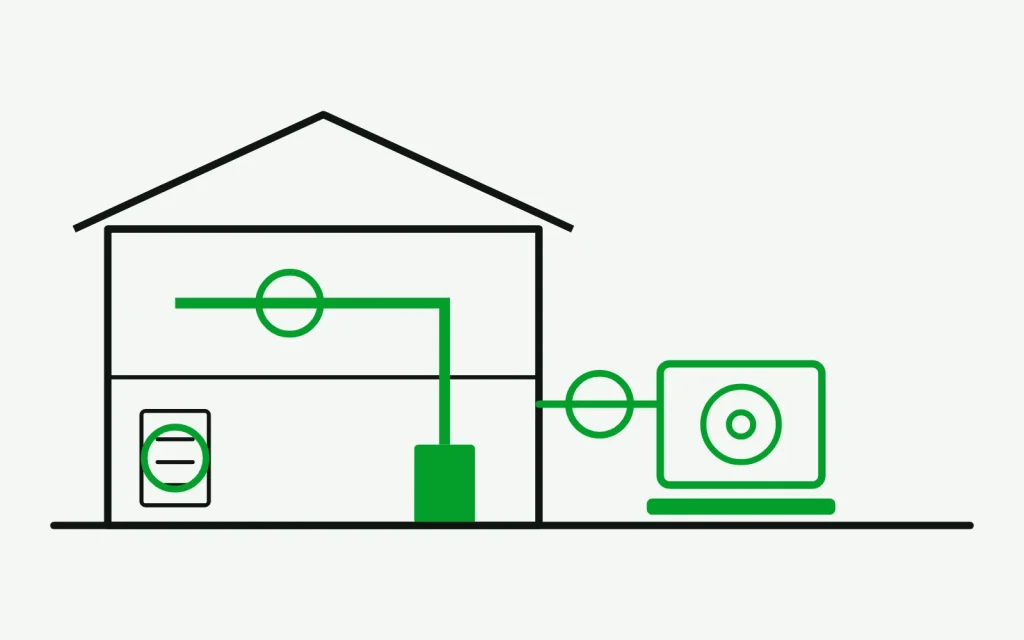
- Where the condenser can go. A flat side yard with a clear path is one price. A rear deck, a roof, or a spot that only a crane can reach is another, and in a dense neighborhood the crane needs a street permit and a morning.
- How far the refrigerant lines have to run. Line-set length is material and labor, and a long vertical run also changes how the system has to be charged.
- The electrical service. A condenser needs its own circuit and disconnect. Panels in older homes are frequently full, and a sub-panel or a service upgrade is a real cost that has nothing to do with cooling.
- The ducts, if there are ducts. Supply runs sized for a furnace are not automatically sized for cooling, and return air is where older systems are usually starved. Sealing, adding a return, or insulating attic runs shows up in the honest quote and not in the cheap one.
- Condensate and access. A coil produces water all summer. Where that water goes — gravity drain, condensate pump, an attic pan with a float switch — is decided by the house.
- Permits and inspection. Required, chargeable, and worth confirming who files them.
Sizing changes the price twice
Capacity should come from a room-by-room load calculation rather than from the tonnage of the unit being removed. Skipping that step usually produces an oversized system, and oversizing charges you twice: once for capacity you did not need, and then every summer afterward, because a system that satisfies the thermostat in short bursts never runs long enough to pull humidity out of the air. A house can sit at 72 degrees and still feel like a basement in July.
A quote built on a load calculation is often for a smaller machine than the one being replaced. That is a feature.
The 2026 refrigerant factor
Manufacturers stopped building R-410A residential condensers on January 1, 2025. New systems use lower-GWP refrigerants, and the outdoor unit, the indoor coil, and the refrigerant now have to be a matched, AHRI-listed set. The practical effect on a quote is that the old money-saver — replace the outdoor unit, keep the coil upstairs — is off the table on new equipment. A quote that still offers it is either using pre-2025 inventory, which is legal, or is not describing what will actually be installed.
What a quote worth comparing contains
- Model numbers for the outdoor unit and the indoor coil, listed as a matched set.
- The load calculation, or at least the number it produced.
- Line-set length and route, and where the condenser will physically sit.
- Electrical scope: new circuit, disconnect, and whether the panel needs work.
- Duct work included or explicitly excluded.
- Permit and inspection, named and priced.
- Removal and disposal of the old equipment.
- Warranty terms on parts and on labor, which are two different things.
Line those up between two bids and the gap usually explains itself in about a minute.
One question worth asking before you compare at all
A heat pump sits on the same pad, uses the same lines, and cools identically in summer — it simply also heats in winter, and Mass Save rebates are written for heat pumps rather than for cooling-only systems. Before comparing two air conditioner quotes, it is worth knowing what the third option pays back. The numbers are in our guide to Mass Save rebates in 2026, and the ducted-versus-ductless half of the decision is here.
Our estimate visit is free and includes the load calculation, the line route, and the electrical check, so the quote you get from us is itemized the way the list above describes. Call (617) 404-9944 or see what is involved on the air conditioner installation page.
