
When a furnace reaches the end, the decision is no longer “which furnace”. In Massachusetts in 2026 there are three real options — a new gas furnace, a new oil unit, or a heat pump replacing the whole thing — and only one of them comes with state money attached.
Here is how the three actually compare on the things that matter in a Boston house.
Replacing gas with gas
The simplest path and usually the cheapest to install. The main decision inside it is efficiency: a mid-efficiency unit vents into an existing chimney, while a condensing unit in the mid-90s AFUE vents in plastic pipe through a side wall and needs a condensate drain.
That venting change is the part people do not see coming. Going condensing means new venting, a drain, and sometimes a chimney liner for the water heater that used to share the flue — real work that belongs in the quote rather than discovered on install day.
Replacing oil with oil
Still the right answer in houses with no gas service on the street, and modern oil equipment is far better than what it replaces. Two things belong in the conversation: the age and condition of the tank, because a failing tank is a much larger problem than a failing burner, and the fact that oil ties the household to a delivery schedule and a commodity price.
If the tank is original and the furnace is done, price the two together. Doing them a year apart usually costs more than doing them at once.
Replacing either one with a heat pump
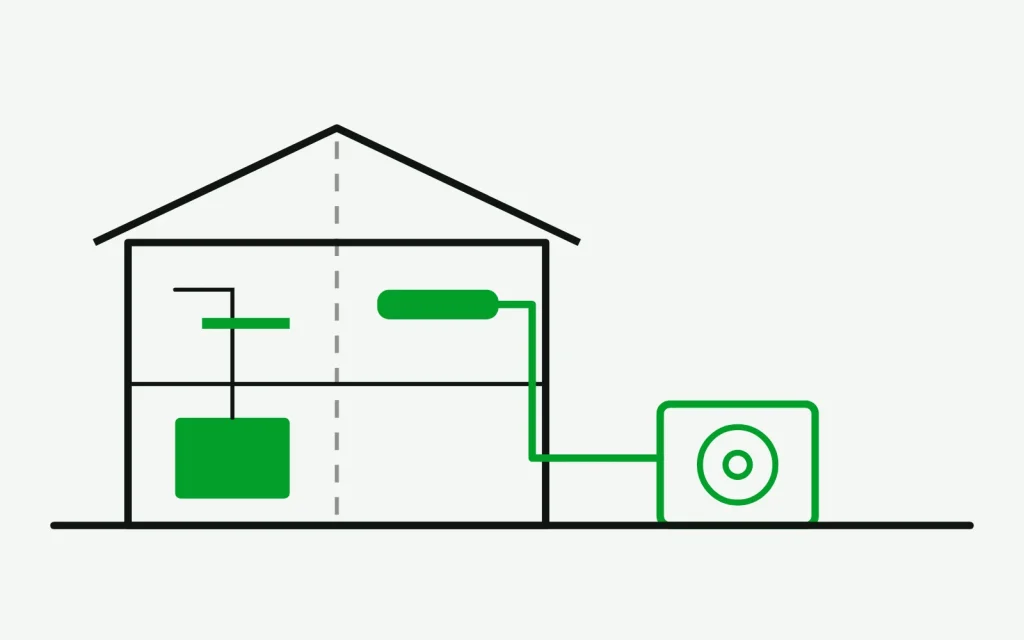
A cold-climate heat pump heats the house and cools it in summer, uses the existing ductwork in a ducted install, and is the only one of the three that Mass Save pays for. That last point is not a detail: the 2026 whole-home rebate runs to $8,500, and there is a 0% HEAT Loan behind it — the full breakdown is in our guide to Mass Save rebates in 2026.
The honest counterweights. Electrical service often needs attention, since a heat pump adds a substantial load and many older Boston panels are already full. Ducts sized for high-temperature furnace air are not always right for the lower supply temperatures a heat pump produces. And running costs depend on the local electricity rate against the local gas rate rather than on a brochure.
The middle path nobody mentions
A dual-fuel system keeps the furnace and adds a heat pump on the same ductwork. The heat pump carries the shoulder seasons, which in Massachusetts is most of the heating hours, and the furnace takes the deep cold. It hedges the fuel-price question in both directions and it suits houses where the envelope is not yet tight enough to go all-electric with confidence.
It costs more than either single system and it is the right answer more often than it gets offered.
Do the envelope math before the equipment math
Whatever goes in should be sized from a room-by-room load calculation, not from the badge on the old unit. Houses lose load over time: replacement windows, attic insulation, air sealing. Sizing to the old equipment installs the mistakes of 1998 for another twenty years.
The order that saves the most money is also the least exciting one: energy assessment, then weatherization, then equipment sized to the improved house. Mass Save ties its whole-home tier to exactly that sequence, which is not a coincidence.
Timing
Replace in the shoulder season if you possibly can. A furnace changed in October is a scheduled project with a load calculation, a rebate application and a choice of equipment. The same furnace changed on the coldest night of January is whatever is on the truck, at whatever it costs to get someone out at 11pm.
If yours is limping, that is the argument for deciding now rather than in the middle of the season.
We quote all three options against the same load calculation so the comparison is real: furnace installation, heat pump installation, and the paperwork for the rebate if you go that way. The estimate visit is free — call (617) 404-9944.
